
Running a public swimming pool or spa in the UK means operating within one of the most tightly regulated environments in the leisure industry. HSG179, PWTAG's Code of Practice, the Health and Safety at Work Act — the requirements are extensive, and the consequences of getting them wrong are severe.
Yet the majority of UK pool operators are still relying on paper logbooks, spreadsheets, and ring-binders to manage compliance. This approach isn't just inefficient — during an inspection or incident investigation, a disorganised paper trail can actively work against you.
PoolComply was built specifically to solve this. Here's exactly how the platform maps to UK compliance requirements, and what it does in practice to keep you covered.
⚠️ Important: Pool operators can face prosecution, unlimited fines, and facility closure under the Health and Safety at Work Act 1974 if they fail to demonstrate adequate management of their water quality and safety obligations.
1. The Digital Logbook: Your Complete Water Quality Record
PWTAG's Code of Practice (Chapter 4) requires that all water quality test results are recorded, including the date, time, result, and the name of the person who carried out the test. This must include at minimum 2-hourly pH and free chlorine readings during opening hours.
PoolComply's water testing module replaces the paper logbook entirely. Every time an operator logs a test, the system automatically captures:
- Date, time, and operator name (linked to their secure login)
- pH, free chlorine, combined chlorine, and temperature readings
- Automatic PWTAG traffic-light status (Ideal / Action Required / Close)
- Langelier Saturation Index (LSI) calculated automatically
- Bather load at time of test
Because every record is tied to an individual user account, it creates the kind of attributable, tamper-evident audit trail that regulators and insurers expect.
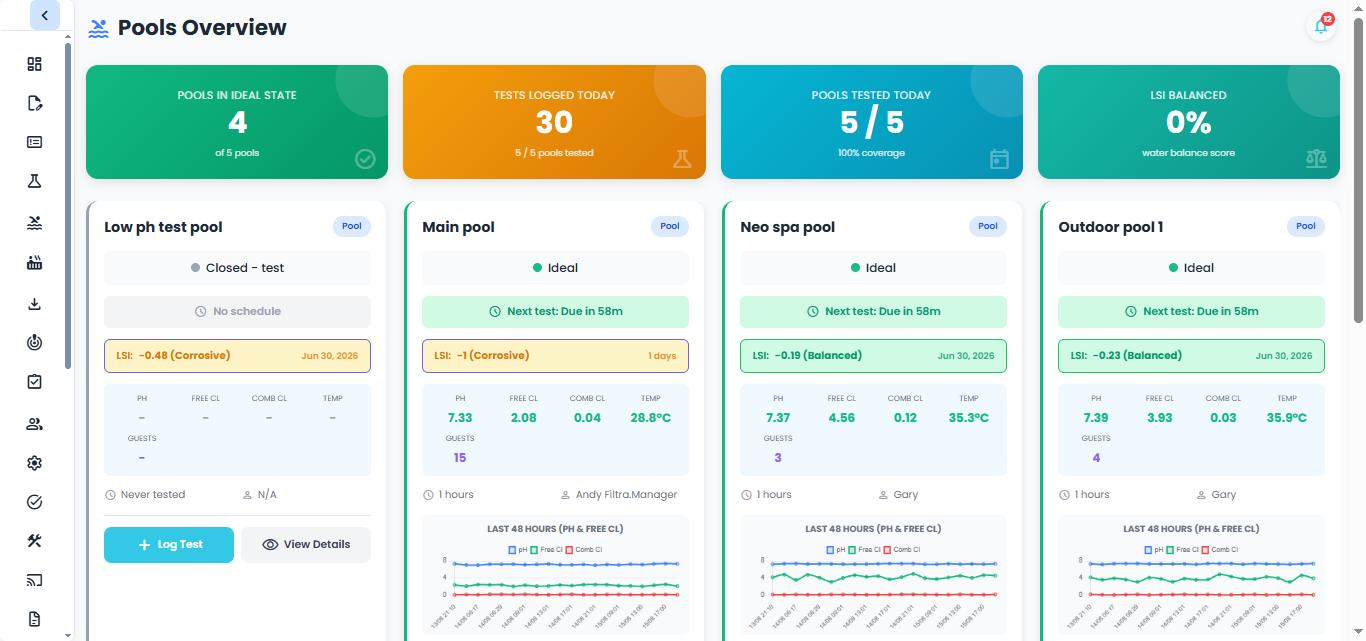
PWTAG CoP 4.1: "Records of all water tests carried out, including the date, time, values obtained and the action taken should be kept." PoolComply satisfies this automatically for every test logged.
2. Automated Testing Reminders & Overdue Alerts
Knowing you need to test every two hours is one thing. Actually making it happen, every shift, every day, for every facility — that's the operational challenge most pool managers face.
PoolComply calculates exactly how many tests are required based on your facility's operating hours, then tracks completion in real time. The Manager Dashboard shows a live count of tests completed vs tests required for the current day.
When a test is overdue, the system escalates the status:
- Due Soon — test due within the next 30 minutes
- Due Now — test window has opened
- Overdue — more than 30 minutes past the required test time
Managers receive email alerts when facilities fall overdue — without having to constantly check. This creates an automatic early-warning system that paper logbooks simply cannot provide.
3. The Compliance Centre: Your Live Audit Score
One of the most distinctive features of PoolComply is the Compliance Centre — a real-time dashboard that evaluates your facility against 22 requirements across three compliance tiers:
- Tier 1 — HSG179/282 Legal Requirements (10 requirements): the legal minimum
- Tier 2 — PWTAG Best Practice (19 requirements): industry gold standard
- Tier 3 — PoolMark Excellence (22 requirements): the highest achievable level
Every requirement is checked against real data in your account. Not a static checklist — an active, live assessment.
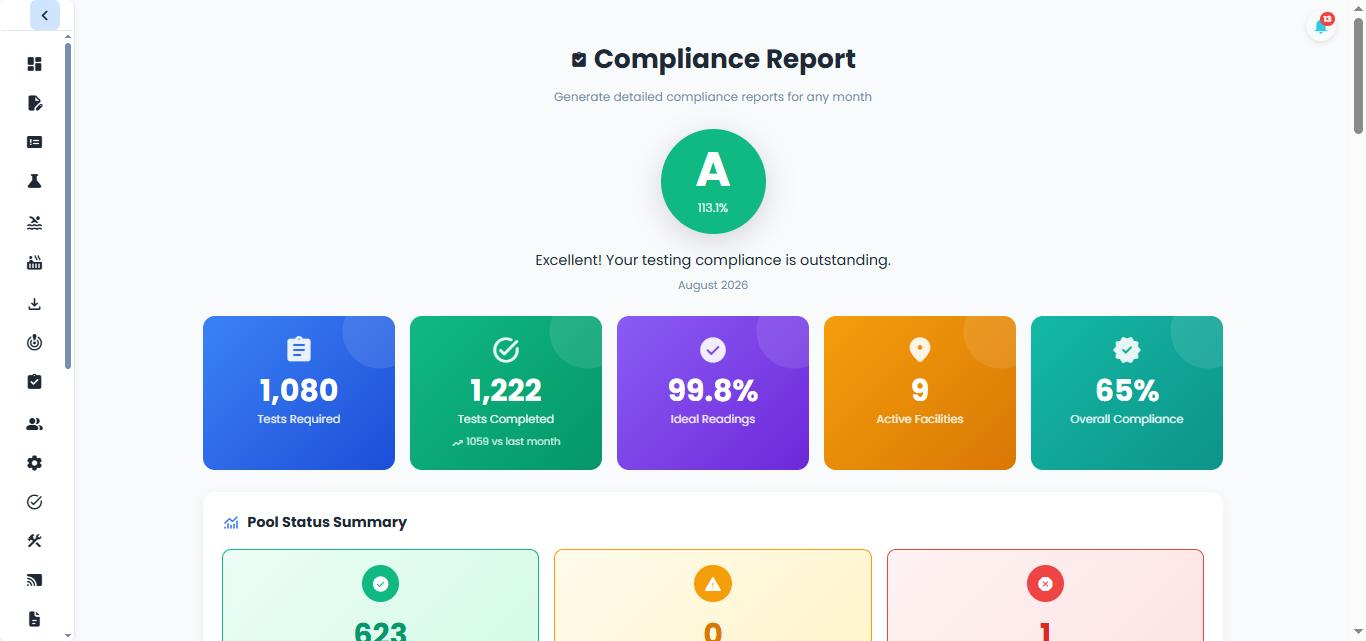
Examples of what the Compliance Centre checks in real time:
- Are water tests being carried out at required frequency today?
- Is combined chlorine staying below 1.0 mg/l (PWTAG action level)?
- Have backwash records been logged in the last 30 days?
- Has daily pool dilution (30L per bather) been recorded?
- Are risk assessment and PTOP documents on file and up to date?
- Do all active staff have pool plant certificates on record?
- Has a microbiological test been carried out this month?
When an inspection arrives, you're not scrambling to gather evidence — you're looking at a live score that already shows your compliance picture.
4. Document Library: All Your Compliance Documents in One Place
HSG179 requires facilities to hold and maintain a range of written documents: a Pool Water Treatment Operating Manual (the PTOP), Emergency Action Plans, COSHH assessments for all chemicals used, Standard Operating Procedures for plant room tasks, and staff training records.
PoolComply's Document Library gives you a central, categorised store for all of these. Every document has a review date, and you're alerted when anything is approaching its review or expiry.

During an inspection: An HSE inspector or local authority environmental health officer can ask to see your PTOP, COSHH assessments, and risk assessments at any time. Having them immediately accessible — rather than in a filing cabinet somewhere — makes an immediate impression.
5. AI Document Generators: From Blank Page to PWTAG-Compliant in Minutes
Most pool operators don't have a compliance manager or a legal team. Writing a PTOP or an Emergency Action Plan from scratch is a daunting task — and most facilities either have outdated documents, generic templates, or nothing at all.
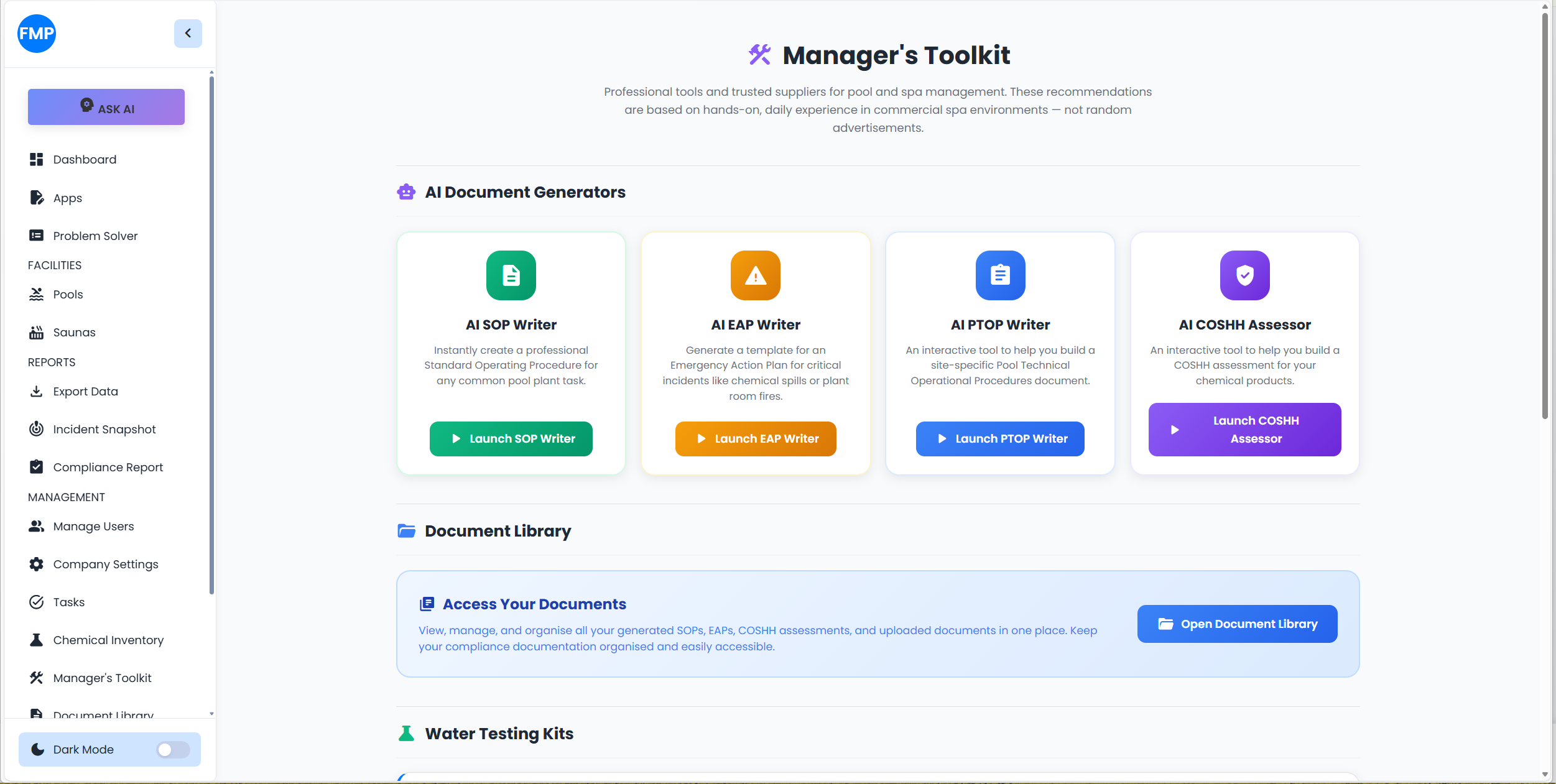
PoolComply's AI document generators create facility-specific compliance documents in minutes:
- AI PTOP Writer — generates a Pool Technical Operating Procedures document specific to your pool type, chemicals, and plant room setup
- AI SOP Writer — creates standard operating procedures for any pool plant task
- AI EAP Writer — Emergency Action Plans for chemical incidents, contamination events, and more
- AI COSHH Assessor — COSHH assessments for your specific chemicals, including PPE requirements and first aid procedures
Try PoolComply Free
Alpha programme open now. One full year of all features, completely free.
Start Free Trial →6. Backwash & Filter Maintenance Records
PWTAG CoP Chapter 6 requires that all filter backwash events are recorded, including the trigger reason, pressure readings before and after, duration, and the name of the operator. This is an area where paper logbooks are particularly poor — entries are often incomplete, inconsistent, or simply missing.
PoolComply's backwash logging module captures every required data point in a structured form, calculates filter run times, and flags when backwash events haven't been recorded in a reasonable period. From February 2026, the system also supports quick "Water Dump / Dilution" logging directly from the PPO Dashboard — satisfying PWTAG CoP 5.3's daily dilution requirement with a single tap.
7. What Actually Happens During a Pool Inspection
An HSE or local authority inspection of a public swimming pool will typically focus on three things:
- Active management — are tests being done at the right frequency? Are results being acted on?
- Documentation — do you have a PTOP? COSHH assessments? Staff certificates?
- Reactive evidence — when things have gone wrong in the past, how did you respond?
PoolComply addresses all three. Your water test history provides an immediate, timestamped, attributed record of active management. Your Document Library holds all required written documentation. And the compliance centre's history shows how your scores have tracked over time — including how quickly issues were addressed.
An inspector who finds a well-maintained PoolComply account is looking at the kind of evidence that turns a potential enforcement action into a clean bill of health.
Real example: A pool facility in our Alpha programme used PoolComply compliance data during a local authority inspection in early 2026. The inspector's report noted "comprehensive digital records with full operator attribution and consistent testing frequency." No enforcement action. No improvement notice. Just a pass.
Getting Started
PoolComply is currently in its Alpha programme, which means the first operators to sign up get one full year of access completely free — all features, no restrictions. This is a genuine opportunity to get your compliance infrastructure in order before it's needed.
If you're running a public or semi-public pool or spa in the UK, the question isn't whether you need a system like this. The question is whether you have one before the next inspection.